
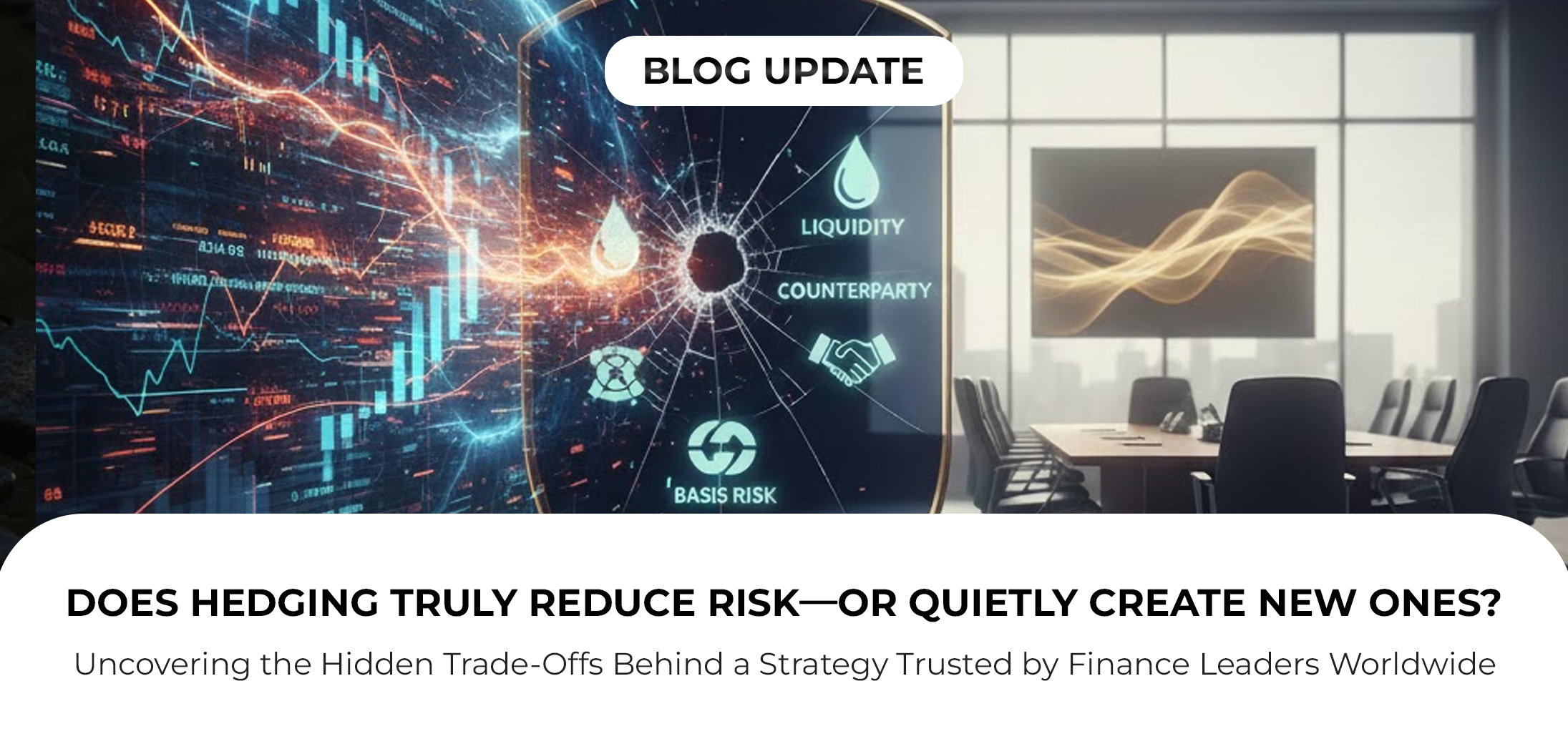
The Paradox of Protection: For years, financial leaders have treated hedging as a bulletproof vest against market volatility. But what if the moment you secure your margins, you unknowingly open the door to a new, more insidious set of financial threats? We rely on derivatives for stability, yet the very act of reducing one risk exposes us to the hidden liabilities of basis, liquidity, and counterparty exposure. Does hedging truly reduce uncertainty, or are we simply swapping visible market danger for invisible balance sheet risk? This is the critical question demanding an honest answer from every finance professional.
The reality is that while hedging successfully mitigates the primary, volatile market risk, it introduces a host of secondary financial and operational exposures that must be carefully managed.
1.The Transfer Mechanism: Price Risk to Counterparty Risk
Forward contracts allow the party to buy or sell an asset at a pre-agreed price on a specified date. This helps the party reduce the risk of a favourable situation arising for them, that is, it reduces the risk of the asset getting sold for a lower price, or having to buy the asset at a higher price from the present date. So, they protect against the future adverse price movements, giving a certainty in the cashflows. This shifts the risk to the counterparty rather than reducing it. The counterparty could default leaving the original risk unhedged.
Similarly, swaps change the stream of cashflow, from floating to fixed or vice versa, but there still exists a counterparty risk, which if the swap provider fails, the exposure remains unresolved.
2. The Introduction of Basis Risk
The use of futures to hedge the commodity or forex exposure locks in a price, creating offsetting gains and losses between the physical market and the derivative market. However, this process can result in basis risk, which is the mismatch in the hedging instrument and the exposure it is intended to hedge. Basis risk can happen due to differences in maturity, location, or the quality/grade of the underlying asset.
Even when the primary market risk is transferred, this misalignment means the hedge may not perfectly track the value of the underlying asset, leaving a residual, unhedged exposure on the balance sheet.
3. The Shift to Liquidity Risk
A company uses traded derivatives like futures to hedge commodity or forex risks, which requires an initial margin payment. Because these contracts are marked-to-market on a daily basis, volatile market movements can lead to unexpected requirements in liquidity, turning into a burden if the company faces existing liquidity issues. This, in turn, can lead to cash flow pressure, margin call risk, and potential breaches of covenants.
Yes, you hedge the price volatility getting yourself exposed to liquidity risk.
4. The Opportunity Cost and Options Complexity
Futures do not allow to take advantage of the favourable movements in the market, which is a downside. But this can be solved by using options. Entering into options requires a premium to be paid, making it costly. There is also a possibility that the value of option erodes over time, if the market moves slowly. This can be entered into if the market is highly volatile, but if there is a sudden change in the volatility, the hedge can be ineffective. This gives a false sense of security with draining resources.
The Bottom Line: Costs and Consequences
Poorly designed hedges can introduce new risks, including liquidity stress, operational complexity, and counterparty exposure. These new exposures can sometimes overshadow the risk they were intended to mitigate, turning a protective strategy into a liability. Over-reliance on hedging can create a false sense of security, masking underlying vulnerabilities.
It is therefore important for companies to look at the costs that arise as a result of hedging, be it the counterparty, basis, liquidity or other risks, and make a decision to hedge or bear the risk. This requires a continuous, disciplined risk management framework, where the cost of the hedge (including premiums and collateral) is weighed against the cost of bearing the risk unhedged. The decision is not merely tactical, but a strategic one that defines the company's ultimate risk appetite.
© 2026 Business Consultant & Law Firm - Legacy Partners. All Rights Reserved.
Designed by Nuewelle Digital Solutions LLP

Legacy Partners
We typically reply in a few minutes